
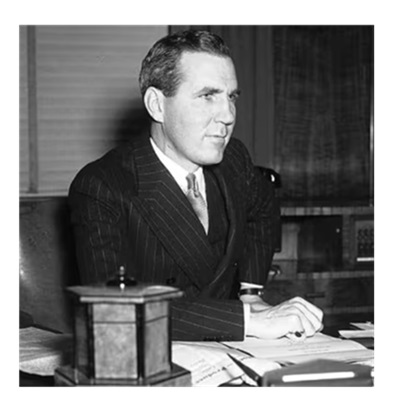

"George McCullagh: forgotten Canadian business builder, founder of the Globe and Mail, Leafs owner"
by Sean Lawlor
George McCullagh (March 16, 1905 – August 5, 1952) was a titan in the realms of Canadian media and sports, wielding considerable influence that extended to conversations with prime ministers and royalty at his zenith. Yet, his name has since slipped into obscurity, seemingly excised from the annals of Canadian history.
Despite his ascent to prominence, today, George McCullagh is a name unfamiliar to many. Born into poverty in 1905 in London, Ontario, McCullagh left high school early to join the workforce. McCullagh's exceptional talent for newspaper sales paved his way into The Globe's operations. His flair for the world of stocks and bonds soon saw him working in a brokerage office. It wasn’t long after that he opened his own firm and soon became a director of Mining Corporation. At the age of 25, George McCullagh was a millionaire.
One day he had the good fortune to be introduced to mining magnate and publisher of The Globe newspaper, William Henry Wright. Soon McCullagh was working for Wright and in 1936 was given $1,300,000 by the publisher to buy his newspaper operation. Within months McCullagh had latched onto another newspaper when he purchased The Globe’s arch-rival, The Mail and Empire for $2,020,000. The young newspaper tycoon brought his two papers together under one name, The Globe and Mail. A dozen years later he added a third paper to his collection with the purchase of The Evening Telegram from the John Ross Robertson estate for $3,610,000. The December 1, 1948 edition of the newspaper, published with a slightly different and more succinct title, The Telegram, featured 43 year-old George McCullagh’s name as publisher.
In addition to being the publisher of two of the country’s most influential newspapers, McCullagh was also a director of several large mining concerns as well as being on the board of the University of Toronto, the National Sanitarium Association, Maple Leaf Gardens, and the advisory board of the Salvation Army. He was also a great philanthropist, giving large amounts of money to both the Toronto General Hospital and Hospital for Sick Children.
George McCullagh's story certainly embodies elements of the media mogul mythos, resonating with the narratives of figures like Rupert Murdoch, Ted Rogers, Conrad Black, Mark Zuckerberg, and Elon Musk. These are stories of individuals who leverage media ownership to exert substantial influence over public discourse and, by extension, political and socioeconomic landscapes. McCullagh's journey from humble beginnings to significant wealth and political influence, marked by his ownership of major sports teams and a pivotal role in the media industry, aligns with this archetype. His rapid ascent and premature demise add a tragic dimension that underscores the mythic quality of his life.
McCullagh's lack of formal education and the almost visceral approach to expanding his empire, particularly his acquisition of The Globe out of spite, suggests a departure from the more calculated strategies often associated with his contemporaries. Yet, this divergence does not diminish his fit within the media mogul narrative; if anything, it adds a unique layer to his legend. His tactics reflect a raw ambition and a keen instinct for capitalizing on opportunities, traits that are frequently romanticized in tales of self-made magnates.
Regarding his political affiliations and influence, McCullagh’s connections with key political figures in Ontario, like Mitchell Hepburn and George Drew, indicate his strategic navigation of political landscapes to consolidate power. By exerting financial and behind-the-scenes control over these premiers, McCullagh managed to wield significant influence at both provincial and potentially national levels. This manoeuvring within political circles is characteristic of media moguls who understand the symbiotic relationship between media power and political influence. It highlights how media ownership can be leveraged to shape political agendas and outcomes, further cementing McCullagh's place in the pantheon of influential media figures.
Notably, the capacity of publishers — not limited to McCullagh but also including the Toronto Star's publisher — to maneuver discreetly and their actual interventions were quite astounding. Despite contemporary perceptions of media tycoons' power, their predecessors, like McCullagh, were directly involved in significant political maneuvers, such as influencing the dismissal of cabinet ministers or covertly communicating with the Prime Minister.
This dynamic with the Prime Minister was complex, marked by a mix of fear and animosity, where Mackenzie King notably wished for McCullagh's demise. Through connections with the Bassett family of Montreal, McCullagh gained access to Winston Churchill's inner circle, likely interacting with figures like Lord Beaverbrook and possibly Churchill himself, alongside Bracken, who played a crucial role during the war.
McCullagh's decline and untimely passing was as abrupt as his remarkable ascent to prominence. There's some debate over the specifics, but it's believed he might have been struggling with severe, recurring episodes of depression, and there's a considerable chance he suffered from bipolar disorder. His life appeared to be marked by cycles of extreme highs, once known as mania, followed by intense lows. These mental health challenges significantly affected him, potentially motivating his pursuit of power as a means of self-protection. His cause of death remains uncertain, with some speculating a heart attack and others suggesting suicide; the truth might remain elusive.
His downward spiral was triggered by two major losses. The death of Dr. Kennedy, his psychiatrist, represented a significant setback. Dr. Kennedy's readiness to use electroconvulsive therapy (ECT) on McCullagh, without accompanying psychological therapy, underscored the depth of their relationship. The loss of his financial supporter and close friend, William Henry Wright, around the same time further compounded his troubles, making the summer of '52 particularly challenging. Despite his efforts to keep going, the impact was evident; at the age of 47, he looked significantly older, eventually culminating in his early demise.
George McCullagh life is a Canadian story that deserves to be heard and remembered. His life was full of daring, business creativity, and strength to build and overcome personal and professional challenges.
Your thoughts? Are we missing something? Ideas for articles, people or research?, let us know. Contact us anytime, hello@21treefinancial.ca. For more unbiased Money articles created by our Money Yoda earthlings - how to make it, save it, grow it, and spend it wisely. Visit us at our 21Tree Financial Blog.